October 09, 2026


An anvil is the one tool in a forge that outlives you. Bought well, it will still be taking hammer blows long after your wrists have given up. Bought badly, it becomes an expensive doorstop and a lesson in why you should never trust a photograph on a marketplace listing. The good news is that the checks that separate a sound anvil from a tired one take about ten minutes and no special equipment beyond a ball bearing and a straight edge.
Most beginners do the same range of jobs: drawing out tapers, shouldering, bending scrolls, punching holes, forming curves on the horn. That work asks three things of an anvil — mass under the hammer, a flat and hard working face, and edges that are intact but not razor sharp. Nothing on that list requires a museum-quality London pattern with a perfect horn.
Be honest about where it will live, too. A 150 kg anvil in a shared garage is a problem; a 40 kg anvil on a job site is a blessing. If you plan to take it to shows, courses or a friend's forge, portability matters. If it will sit in one spot for the next twenty years, buy the heaviest thing you can move.
The anvil is a reflector. Your hammer puts energy into hot steel, and whatever the anvil and its mounting absorb is energy that never reaches the workpiece. More mass means less bounce lost into the stump and the ground, which means fewer blows for the same amount of drawing out. This is why a small anvil feels exhausting: you are working hard and the metal is barely moving.
A common rule of thumb among smiths is that the anvil should weigh roughly fifty times your hammer. With a 1 kg hammer, that puts you at about 50 kg, and that is a sensible floor for a first serious anvil. Old farrier's anvils often come in around 30–50 kg; farm and industrial anvils sit between 70 and 150 kg. Weight is the single best predictor of how much you will enjoy using it.
Learn to read the markings. Older British anvils are often stamped in hundredweights, quarters and pounds — three numbers. So 1 2 14 means one hundredweight (112 lb), two quarters (56 lb) and fourteen pounds: 182 lb, or roughly 83 kg. A seller listing "1 2 14" as "112 kg" is simply wrong, and it is worth knowing before you travel.
The face is the hardened steel top plate, and it is almost always the reason an anvil is cheap. Check it in daylight, with the anvil dry.
Counter-intuitively, a razor-sharp edge is a downside for a beginner. Sharp edges chip, and they mark your work. A slightly rounded edge is more forgiving and easier to work against.
Do this with the anvil where it sits, not after you have loaded it. An anvil resting on soft ground or a rotten stump will feel dead no matter how good it is.
New cast steel anvils from established makers give you a known hardness, a genuinely flat face, clean edges, a warranty and a predictable weight. You pay more per kilogram than you usually would second-hand, and the smaller sizes are tempting because they are cheaper — resist that. Buying new is the low-risk route, particularly if you cannot inspect in person.
Cheap cast iron anvils sold with a painted face and a hopeful description are the one thing to avoid outright. Cast iron is soft and brittle; the face will dent under a hammer and the edges will crumble. A 30 kg block of mild steel offcut set in a stump, or a piece of forklift tine, will serve you far better for a first year, even without a horn or hardy hole.
Second-hand is where the character lives. Look at farm dispersal sales, machinery auctions, car boots, reclaim yards and the classified sections of blacksmithing groups. Anvils have become fashionable as interior decoration, so expect competition from buyers who care about the patina and not the face — and do not pay a premium for a coat of black paint that is hiding pitting.
Condition beats brand every time. A no-name English anvil with a flat face and honest edges will outwork a famous name with a swayback. If you cannot view before buying, ask for close-up photographs of the edges, the markings and the underside, and agree the return terms in writing before money changes hands. Where you can, take someone who has swung a hammer for years.
An anvil on a bouncy pallet wastes half your effort. Set it on a hardwood stump, a steel stand or a solid timber block, and secure it — a chain over the feet, or brackets, is enough. Height matters: with your arm relaxed, the face should sit roughly at knuckle height, or slightly lower if you plan heavy striking.
Then deal with the noise. Anvil ring is genuinely loud and travels further than you expect. A magnet clamped under the heel, a length of chain wrapped around the waist, or a sand-filled base will take the edge off it. Wear ear defenders anyway, and think about your neighbours before you start a Saturday morning session.
Buy the heaviest anvil you can move and afford. Aim for 50 kg or more. Check the face before anything else, then test rebound with a ball bearing and listen to the ring. Prefer a plain anvil in good condition over a branded one with a dished face, and walk away from cracks, welded heels and anything made of cast iron. If the budget is tight, a heavy steel offcut is a perfectly respectable place to start.
One last piece of advice: buy once, buy heavy, and put the money you save on a lighter anvil into a decent hammer and a set of tongs. Those are the tools that will teach you to forge.
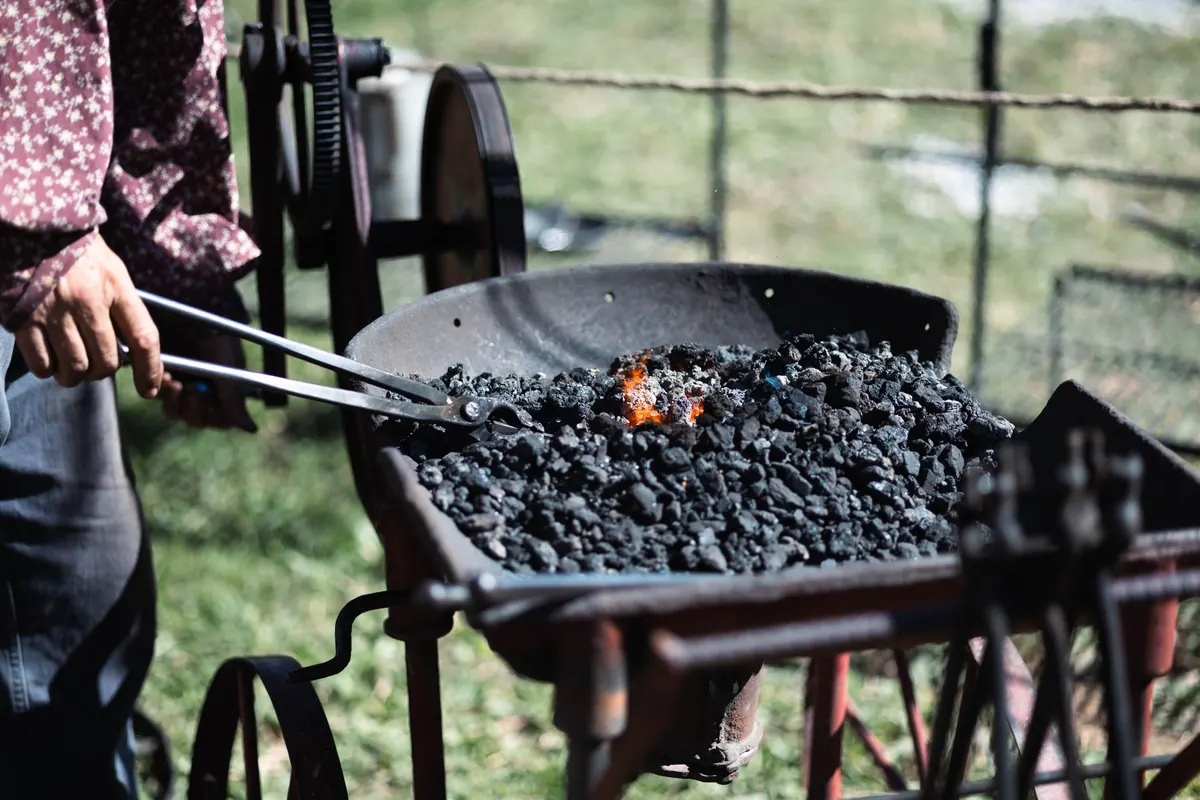
Photo: jenszhonk / Pixabay
The magazine for blacksmiths and metalworkers.
Copyright © 2026 Forge Mag. All rights reserved. Forge Mag.