October 09, 2026



Every forge fire is a negotiation between fuel, air and the iron in front of you. Change the fuel and everything shifts: how long it takes to light, how hot you can push it, how often you stop to clear the grate, and how much smoke drifts over the fence. Coal, coke and charcoal will all bring steel to a working heat. They simply ask for different things in return.
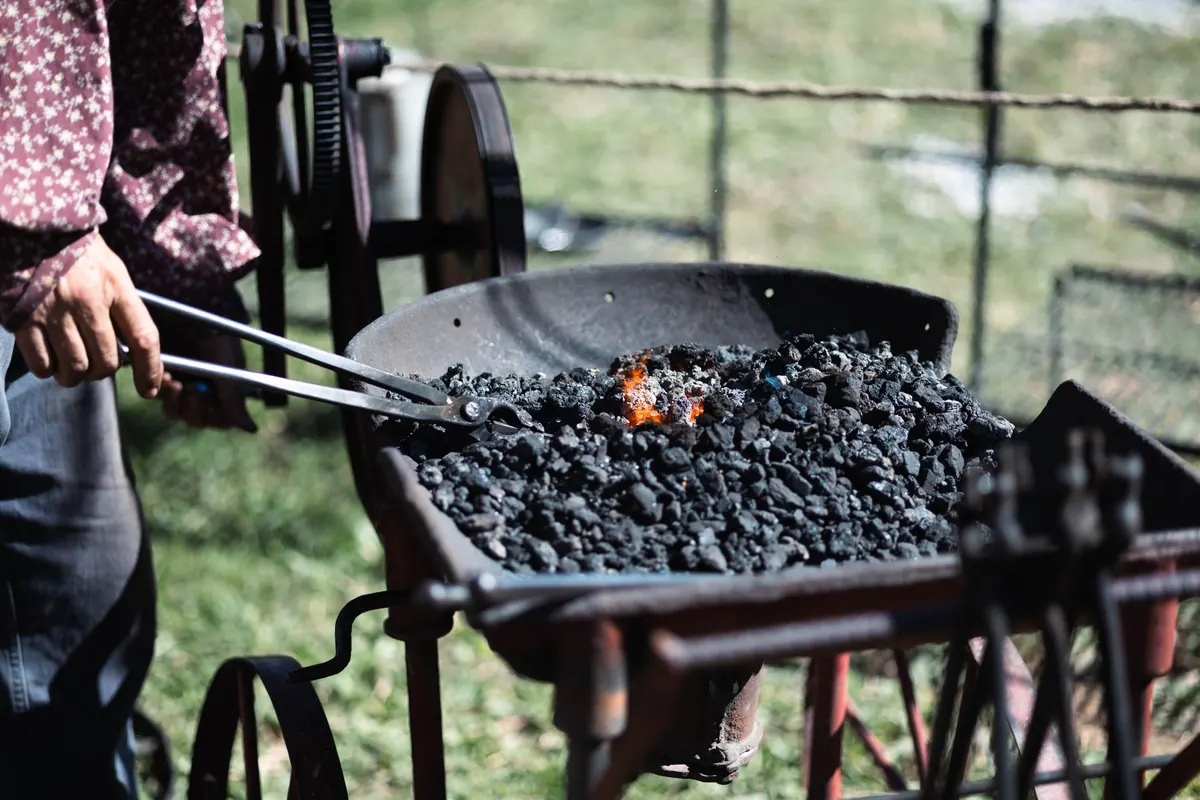
Smithing coal is a soft, bituminous coal chosen for the way it behaves under heat. You light a small wood fire, add a handful of coal around it, and the coal softens and swells as the volatiles burn off. What's left is coke — a spongy, glowing mass you can shape with a rake. That's what gives you the classic cave fire: a hollow dome of concentrated heat you can push the work into.
This is the fuel most traditional British smithies were built around, and it remains the most forgiving choice for forge welding. You can build a deep, narrow fire that holds its heat, so the work sits in the hot spot instead of being chased around the pot.
The trade-offs are smoke, smell and clinker. Fresh coal smokes heavily until the volatiles burn away, and there's that sulphurous tang people associate with a forge. Clinker is the melted ash and impurities that fuse into a glassy, sticky lump at the bottom of the fire. It strangles your air supply, so rake it out — easiest when the fire is at its hottest and the clinker lifts away in one piece — then rebuild the fire around the hot core.
Coke is coal with the volatiles already driven off, which is why it smokes so little once it's running. It burns hot and clean, produces far less clinker, and won't fill a small workshop with fumes.
Getting it lit is the awkward part. Coke wants kindling and patience — or better, a bed of hot coke left over from last time. It also burns hungry, and it tends to burn hollow: a hole opens in the middle of the fire and the heat collapses into it unless you keep pushing fuel in from the sides. The fire is shallower than a coal cave, so it suits general forging better than deep welding work.
Charcoal is what smiths burned long before coal took over. It's almost pure carbon, lights quickly, burns clean once the kindling smoke has passed, and leaves a light ash that never turns into clinker. The heat is broad and steady rather than fierce and pinpointed, which suits smaller work, decorative ironwork and anyone who needs to keep the neighbours on side.
Two cautions. Use lumpwood charcoal rather than barbecue briquettes; briquettes are bound with additives, throw off more ash and smell odd in a forge. And expect to feed the fire constantly, because charcoal burns away quickly. It is usually the most expensive fuel per hour of the three.
Any solid fuel fire makes carbon monoxide, and a forge in a closed workshop is a genuinely dangerous place to be. Keep a door or window open, make sure your chimney or hood draws properly, and fit a carbon monoxide alarm. If you're unsure about the ventilation in your space, get proper advice before you start burning.
Coal is the smokiest of the three, and a cold, smothered fire smokes worst of all. Light it small, let the kindling establish, and add fuel around the edges of the hot core rather than dumping it on top. If smoke is a nuisance locally, coke or charcoal will make you far fewer enemies. Some parts of the UK are smoke control areas with rules about which fuels can be burned, so if you're unsure whether your workshop is affected, ask your council's environmental health team before you set up.
Coal and coke want a covered bin or bunker, raised off the ground so the bottom of the pile isn't sitting in water. Wet coal still burns, but it steams, takes longer to catch and wastes heat drying out. Charcoal is the opposite problem: it drinks moisture from the air and becomes miserable to light, so keep it in a dry, lidded bin. Store fuel away from the workshop wall and anything combustible, and never pile a big heap of coal against timber. Ash and clinker go into a metal container outside — ash stays hot for days.
Sourcing is patchier than it once was, but agricultural merchants, farrier suppliers and blacksmithing suppliers are the usual routes. Quality varies enormously between seams and merchants: some coal cokes beautifully and welds well, some is half clinker. Buy a small amount first and test it before committing to a pallet.
There's no single correct answer. Charcoal suits a small garden forge and a smith who doesn't mind feeding it. Coke suits the tidy workshop. Coal suits anyone who wants the deepest fire and doesn't mind the smoke and the clinker hook. Try all three if you can — your fire, your neighbours and your arms will soon tell you which one fits.
Photo: Owen.outdoors / Pexels
The magazine for blacksmiths and metalworkers.
Copyright © 2026 Forge Mag. All rights reserved. Forge Mag.