October 09, 2026


Most beginners buy too much, too soon. The kit that actually gets you forging is smaller than the internet suggests: a hammer that suits your hand, tongs that grip your stock, something to hit on, and gear that keeps you out of A&E. Buy those four things well and the rest can wait until the work tells you what it needs.
You can forge on almost anything heavy, hard and flat. A second-hand anvil is ideal, but a length of railway track, a thick offcut of steel plate or a purpose-made stump anvil all work. Avoid anything sold as an anvil-shaped object: cast iron, hollow, and useless the moment you hit it. Set the top at roughly knuckle height when you stand beside it, and strap it down so it does not walk across the floor.
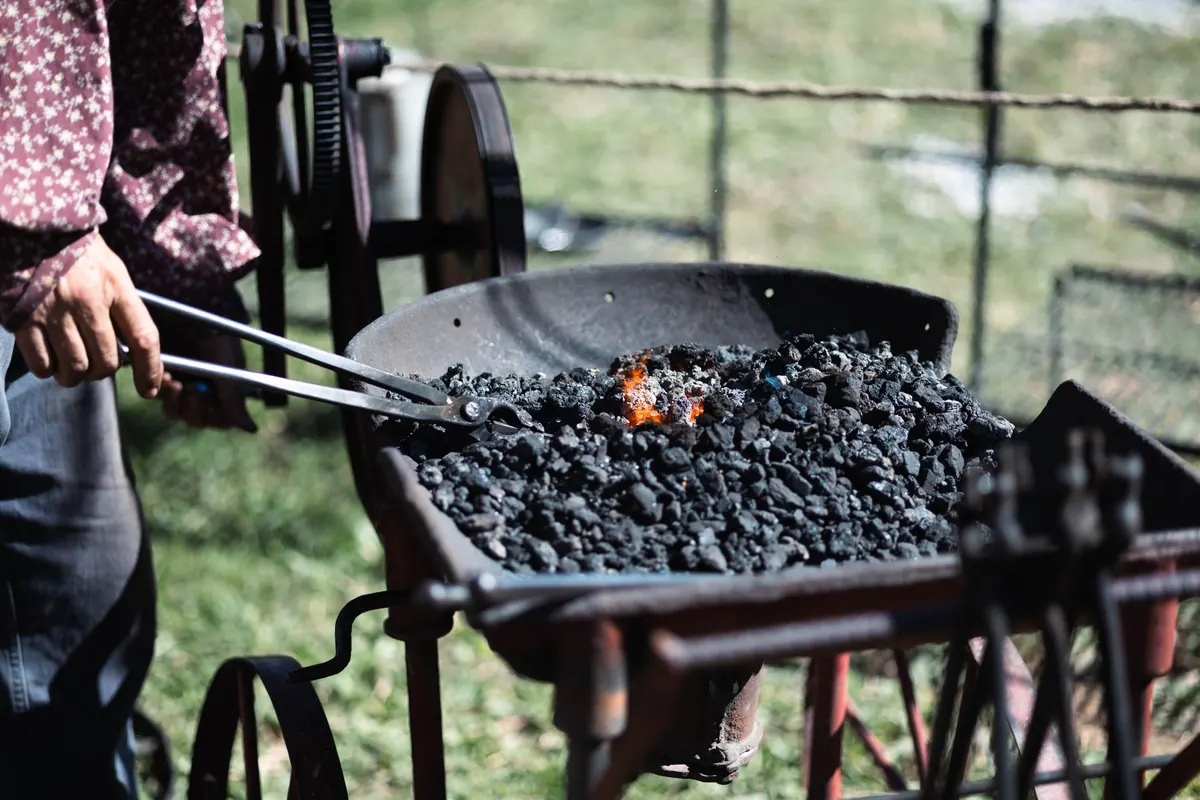
For fuel, solid is the cheapest way in. A brake-drum forge, lump charcoal or coke, and a low-volume air supply will get metal moving. A gas forge is cleaner and easier to control, but it needs proper ventilation — never run one in a closed garage.
For general forging you want a hammer of around 800g to 1.1kg — roughly 2 to 2.5lb — with a wooden handle. A cross pein draws metal out quickly; a ball pein is easier to find second-hand and does almost everything a beginner needs. Both are fine. Buy one.
Car boot sales and farm auctions are good hunting grounds, and older heads are often better steel than cheap new ones. Leave claw hammers alone — too light and wrongly balanced for forging — and stay away from sledgehammers until you genuinely need one. Skip the seven-hammer beginner bundles.
Tongs exist to hold hot metal safely and comfortably. Two pairs will carry you a long way: flat-jaw tongs sized to the stock you use most, say 8mm or 10mm square, and a pair of pick-up or wolf-jaw tongs for odd shapes and thicker bar.
Fit matters more than brand. The jaws should meet evenly along their length and grip when nearly closed, not just at the tips. The reins want to be long enough that your knuckles clear the work. Tongs that do not fit mean dropped steel and scorched boots, so try before you buy where you can, or make your own from flat bar once you can forge a taper. A stripe of paint near the reins is a cheap way to mark which pair fits which stock.
A leg vice — sometimes sold as a blacksmith's vice — is the one to hold out for. It is built to take hammer blows and heavy bending, and its long leg carries the force down to the floor. Bolt it to a solid bench or post with the top of the jaws somewhere near your elbow height.
A cast iron bench vice is fine for filing, sawing and holding metal while you cut, but do not hammer on it or hang a length of pipe off the handle. You will crack the slide. Whichever you use, remember that a vice holds cold work; hot metal belongs in tongs.
Round out the bench with a wire brush, a large second-cut file and a card to clean it, a hot cut hardy if your anvil has a hardy hole, and a metal quench bucket with a lid. The lid stops the water evaporating and keeps the rust down.
This is the part beginners trim first, and the part that matters most.
If you are unsure about ventilation, fuel storage or
Photo: Alexas_Fotos / Pixabay
The magazine for blacksmiths and metalworkers.
Copyright © 2026 Forge Mag. All rights reserved. Forge Mag.